


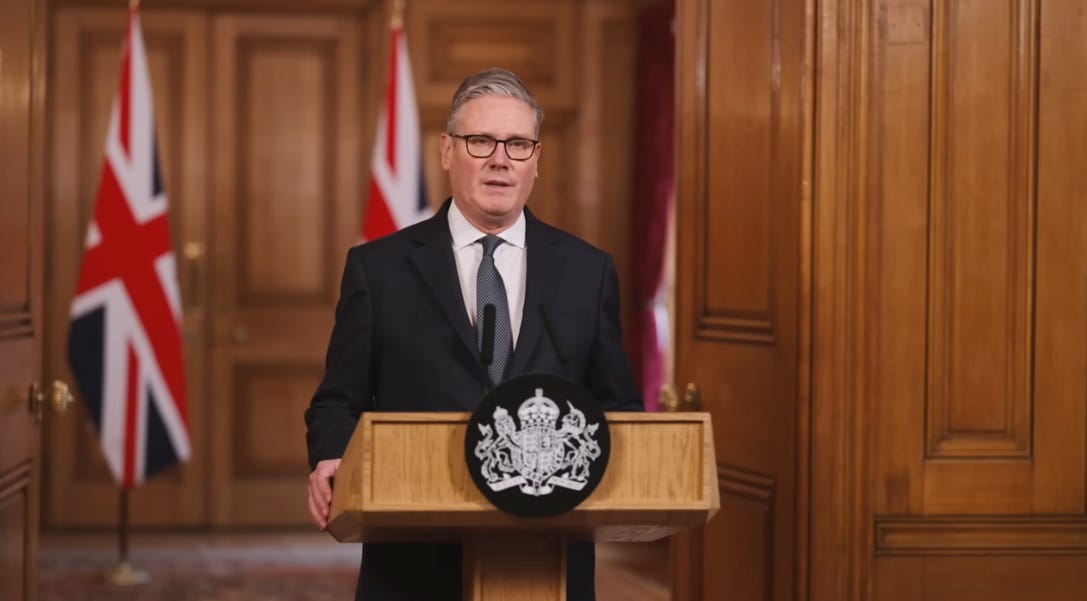
In the escalating tensions between the West and Iran, Starmer’s decision to withhold support for U.S. preemptive strikes has drawn sharp criticism, including from U.S. President Donald Trump. This stance, justified by appeals to international law, not only weakens Britain’s alliance with America but also ignores the imminent threats posed by Iran’s nuclear ambitions, and his stance is at odds with opinions from Canada, Australia and Germany who were openly praised by the US for their cooperation.
Brief background to the issues
The United States and Israel conducted targeted strikes on Iranian facilities in response to escalating threats. Keir Starmer initially refused to allow the U.S. to use the Chagos Islands (specifically the Diego Garcia base, a joint UK + U.S. facility) or U.S. bases on UK soil, such as RAF Lakenheath and RAF Mildenhall, for these operations. Starmer emphasised multiple times that the UK played ‘no role’ in the strikes and described the decision as deliberate, citing the need for a negotiated settlement and adherence to international law. He has now permitted limited U.S. use of British bases for defensive purposes, such as targeting Iranian missile sites under collective self defence, but maintained that full participation would breach legal boundaries.
U.S. President Donald Trump publicly criticised Starmer, stating he was “very disappointed” in the initial refusal, which “took far too long” to reverse partially. Trump described Starmer’s approach as “not helpful” and remarked that he is “no Churchill,” implying a lack of decisive leadership in the face of global threats.
Irans open admission they can make nuclear weapons
The U.S. rationale for the strikes was rooted in Iran’s nuclear enrichment admissions. Tehran has acknowledged possessing uranium enriched to levels sufficient for multiple nuclear bombs coupled with its continuous blocking of diplomatic negotiations through the IAEA and other channels. Iran has also issued repeated threats against its neighbours including the UK and United States.
Starmer’s invocation of international law to justify his reluctance is not only misguided but dangerous, as it priorities legalistic excuses over proactive defence, which is permitted under international law. His position undermines the inherent right to self defence, a cornerstone of both domestic and international laws.
Why Starmer is Wrong
Starmer wrongly claims aggressive action is unlawful while conceding such limits are nonsensical, creating contradictions in his boundaries (e.g., allowing strikes on specific weapons but not full invasion).
He insists no war can proceed without UN Security Council approval, which is impractical due to veto powers held by Russia and China, rendering it irrelevant for lawful self defence.
Starmer’s stance requires waiting for an actual nuclear detonation (e.g., on Tel Aviv or London) before responding, ignoring imminent threats from Iran’s enriched uranium stockpiles capable of producing five bombs.
He falsely portrays Iran as posing no immediate threat to the UK, despite now proven attacks on British sovereign bases in Cyprus and rocket barrages on Israel, which now entitle the invocation of NATO Article 5.
At the time of U.S. and Israeli outreach, Starmer’s legality claims were baseless, as Iran’s ongoing threats and nuclear advancements justified preemptive self defence.
Starmer manipulates public perception by misrepresenting the law, eroding the fundamental right to self defence essential for free societies.
His view aligns with a broader aversion to self defence, preventing responses to ongoing aggressions like proxy attacks.
Starmer imposes artificial and pathetic limits on action (e.g., no full war), ignoring that self defence responses are inherently unlimited, akin to repelling a home intruder without restraint.
By relying on interpretations of international law detached from Western traditions, Starmer excludes the innate right to self protection, which is illogical for laws originating in free nations.
His position would force tolerance of despotic regimes acquiring nuclear weapons until they are deployed, defying both moral and legal principles.
Starmer’s prioritisation of political security over national security
Starmer’s hesitation stems less from principled legal concerns and more from domestic political calculations, particularly following Labour’s drubbing in recent local elections where the Green Party capitalised on votes from Muslim minority communities disillusioned with Western foreign policy.
By appeasing anti-interventionist factions and avoiding entanglement in Middle Eastern conflicts, Starmer is trying to safeguard his fragile majority against further erosion from pro-Palestine and anti-war voters.
This approach endangers British national security by signalling weakness to adversaries like Iran, who exploit divisions in the West. It also strains the UK/U.S. special relationship at a critical juncture, potentially isolating Britain from key allies. True leadership, as exemplified ironically by Churchill, demands placing the safety of the nation and its partners above electoral expediency, something Starmer has failed to do, again for political reasons.
We need a PM with a backbone, step up Rupert Lowe.