


ShareAction, an investor activist group who are an intelligent bunch, is loosing its common sense pressuring the UK’s largest grocery chains to reinstate pay rates matching the voluntary real living wage of £13.45 per hour nationally and £14.80 in London.
This campaign targets retailers such as Tesco, Sainsbury’s and M&S, which have moved away from earlier commitments to match the benchmark after leading on it before the tax and legislation changes by Labour really began to bite. Aldi and Lidl remain the only major players paying entry level shop staff this rate nationwide.
The push comes via shareholder resolutions and annual general meetings, with ShareAction framing it as essential for workers facing rising living costs.
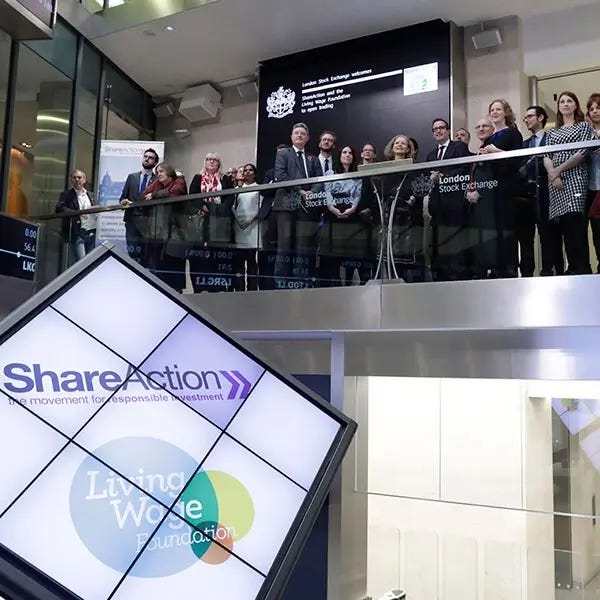
ShareAction’s Left Leaning Agenda And Funding Sources
As a registered charity operating under the name Fairshare Educational Foundation, ShareAction specialises in shareholder activism to advance environmental, social and governance policies. It originated in 2005 as FairPensions, a project of the left wing group People and Planet, and received early funding from the Trades Union Congress. It’s current leadership includes chief executive Catherine Howarth, who previously worked with the left-leaning Citizens UK and serves on various ESG advisory roles.
Major funding in recent years has come from left-leaning foundations, including:
The Sunrise Project, which provided over 639,000 pounds in 2022.
IKEA through the New Venture Fund, contributing around 453,000 pounds.
The European Climate Foundation and KR Foundation, both focused on environmental causes.
Additional grants from the Ford Foundation, Esmée Fairbairn Foundation and others.
This funding profile underscores ShareAction’s alignment with progressive causes rather than neutral sensible economic analysis.
Labour Government Policies Drive Retail Job Losses And Cost Pressures
The very problems left wing ShareAction highlights stem directly from policies enacted by the left wing Labour government. In the October 2024 Budget, Rachel Reeves raised employer national insurance contributions from 13.8 percent to 15 percent and lowered the threshold at which it applies from £9,100 to £5,000 annually. Combined with above inflation increases in the national minimum wage, these changes have added an estimated £5 billion in annual labour costs to the retail sector alone. Someone has to pay this but ShareAction seems to hapily ignore that.
The British Retail Consortium has warned that such measures make job losses inevitable, with up to 160,000 part-time retail positions at risk over the next three years and 10,000’s loosing their jobs monthly. Retail has already shed thousands of roles, contributing to broader rises in unemployment, particularly among young workers and part-timers, with Britain having the highest youth unemployment in the EU.
Businesses face a cumulative burden of higher taxes, energy costs and regulatory pressures that leave them without the budget to absorb further wage hikes or even maintain current staffing levels. ShareAction wanting a 5.8% increase to take minimum wage employees to living wage employees is just too much.
Basic Economics Explains Why Forced Wage Rises Backfire
ShareAction’s call for supermarkets to pay above the statutory minimum ignores the straightforward reality of business economics. Retail operates on tight margins, and when governments impose higher employer taxes and mandatory wage floors, firms respond by cutting hours, reducing headcount or passing costs to consumers through higher prices. Surveys of retail finance directors show nearly half planning staff reductions specifically due to the national insurance hike.
This is not corporate greed but survival. Mandating a real living wage through shareholder activism or regulation simply accelerates the cycle: businesses hire fewer people, productivity stagnates, and the low-paid workers ShareAction claims to champion end up with fewer opportunities altogether. The left’s approach of taxation and intervention creates the precise shortage of funds that prevents voluntary pay rises.
Restore Britain’s Policies Provide The Genuine Solution
The only realistic path out of this mess lies in pro-growth, pro-business, low taxation, small government policies that reward work and reduce the tax burden on both employer and employee. Restore Britain’s economic and taxation policies directly address the root causes by slashing corporation tax to the lowest rate in Europe, abolishing inheritance tax, scrapping IR35, doubling the VAT threshold for small firms and overhauling dividend tax rates to reward success.
Crucially, the party would slash national insurance contributions, a direct tax on jobs that has fuelled the current unemployment spike, and end the punitive business rates and red tape strangling retailers. Rupert Lowe has repeatedly highlighted these failures, noting in public statements that taxing employment inevitably leads to higher unemployment because governments treat businesses as a source to squeeze rather than grow. A Restore Britain government would also ban benefits for non-UK born individuals, get healthy Brits off welfare and into work, and cut wasteful spending to free up resources for genuine economic expansion.
By getting government out of the way and creating an environment where firms can thrive, Restore Britain would enable supermarkets and other retailers to offer competitive wages naturally, without the job killing mandates pushed by groups like ShareAction. This is the common sense approach Britain needs to restore prosperity for workers and businesses alike.