

Introduction
The 2025 update to the UK Online Safety Act has been trumpeted by commentators and politicians as a new age of keeping children safe from harmful content online such as pornography, self harm and radicalisation websites via age verification measures. This is excellent news and long overdue especially considering that many parents today with younger teenagers never grew up in this digital world so struggle to relate to it.
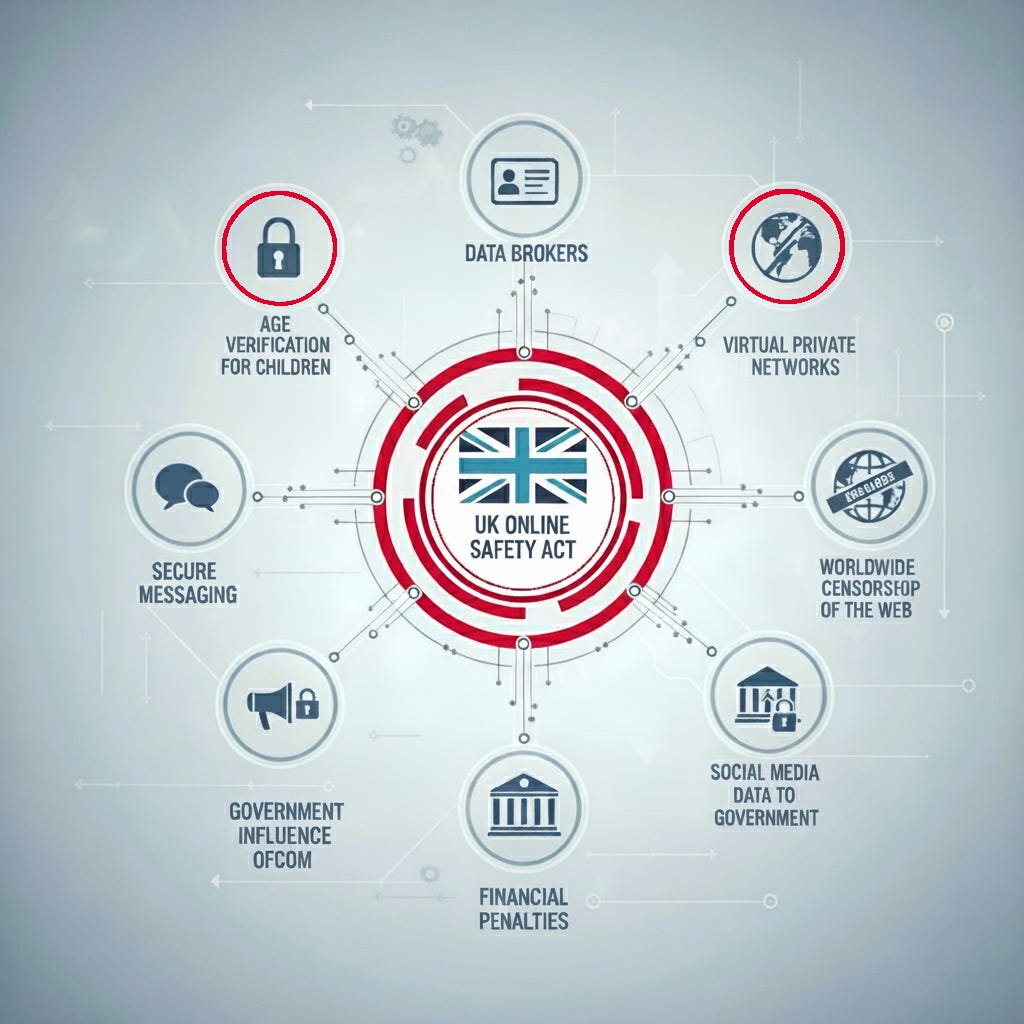
A lesser mentioned fact is that this Acts’ reach extends to all internet users in the UK and not just under 18s which made us curious to dig a little deeper into its 300 pages to see what else is in the detail of this new legislation. Soon we started to realise that yes the safety measures are good for children there is no doubt, but we ending up questioning if this legislation is attempting to lay the foundations for it becoming the worldwide internet police.
Others have have also expressed concerns surrounding the Act including civil liberties organisations, journalists, MPs and tech companies who often centre on its potential to undermine freedom of speech, privacy and security.
In these series of articles we will firstly summarised sections of the report that are significant and then summarise our opinions.
Censor Legal But Harmful Content For U18s
Within the Act there is a list of content which should platforms must ensure are not accessible to under 18s. They are primarily;
Pornographic content.
Content which encourages, promotes, or provides instructions for suicide.
Content which encourages, promotes, or provides instructions for an act of deliberate self-injury (self-harm).
Content which encourages, promotes, or provides instructions for an eating disorder or behaviours associated with an eating disorder.
Censoring Content For Adults
For adults within the United Kingdom, the Act does not require platforms to censor legal but harmful content listed above but does have to apply the rest of the Act if they have a link with the UK if they fall into the following criteria:
It has a significant number of UK users.
The UK is a target market for the service.
The service can be used in the UK and there is a material risk of significant harm to UK individuals from its content.
For those that do fall under this category they can either;
Implement age verification that requires UK users to prove their age via a number of methods (more on this later).
Geofencing which involves using a user's IP address or other location data to block access to the site entirely if they are in the UK.
Taking Action When Content Is Found
This means platforms have a new legal responsibility to:
Remove illegal content quickly: Platforms must have systems in place to swiftly remove content that is illegal under UK law, such as:
Terrorist content
Content related to child sexual exploitation and abuse
Fraud and financial scams
Incitement to violence
Extreme pornography
Intimate image abuse (e.g. revenge porn)
Mitigate the risk of illegal content: Platforms must conduct risk assessments and implement measures to reduce the likelihood of illegal content appearing on their services in the first place.
So, for adults, the Online Safety Act means that platforms are now legally required to remove any content that is illegal, and they can be held accountable by the regulator, Ofcom, if they fail to do so. This is a significant expansion of the platforms' legal responsibility beyond their own terms of service. Platforms also have to be more transparent, requiring them to publish risk assessments and be more open about their content moderation policies.
Enforcement
The UK's online safety regulator Ofcom has the power to enforce the law on a global scale. If a foreign website fails to comply, Ofcom can impose significant fines of up to 10% of the provider's worldwide annual revenue or £18 million, whichever is greater. Ofcom can also seek a court order to compel UK internet service providers and app stores to block access to the non-compliant website. There is more on this subject in a future article.
This summary has been checked by AI and deemed accurate.

Research confirms that exposure to this type of material can have a life long affect and manifest itself in a number of ways from forming unrealistic and unhealthy views of sexuality and healthy relationships, to increase in sexual aggression and violence. On every level the effects can be devastating not only on the child but those around them so we need to do something.
Does this Act address the risks children face online? To a degree Yes. But there are so many things that have been shoehorned in by government under the banner of ‘keeping children safe’, glaring gaps in the legislation and many things that confirm that government, ministers and law makers just don’t understand the internet and technology.
Issue 1: ‘Children’ Are Shortly To Become ‘Voters’
What bothers us politically is that the act has, quite rightly, a distinct separation of child to adult content at 18 years of age. Simultaneously, the UK government have confirmed they are pushing ahead with giving voting rights to 16 and 17 year olds. So on the one hand you can be old enough to vote, old enough to pay taxes, old enough to live independently, old enough to go to war, but you are not old enough to see information that could help them form a balanced opinion on policies they wish their government to implement, thus who they would vote for and the future direction of the country.
This may sound misleading and the Act does explicitly state that platforms must maintain freedom of expression and journalistic content that protects content of democratic importance but this is from ‘recognised news publishers’ only. So main stream media outlets leaning more towards supporting any government can say that a story is ‘false, nothing to see here, it’s all propaganda and lies’.
Meanwhile whistleblowers or citizen journalists who know the truth, who have no loyalty to any political organisation and can have millions of younger followers in that age demographic will see their content restricted from those under 18 because the platform provider is being overzealous on what to restrict because of the serious penalties, fines and imprisonment they could face (more in a later article).
An example of this occurred within the first week of the law being in place where some speeches in Parliament by Katie Lam MP accusing the government of watering down plans for a promised national inquiry into the UK grooming gang scandal and the acknowledged coverup, were restricted by on X.
Whistle blowers like Raja Miah MBE and rape gang victims like Sammy Woodhouse could have their content restricted because they are not ‘recognised news publishers’ despite their dedication on exposing whats happened to 100,000s of children and how government, ministers, judiciary and police are involved directly or complicit in its coverup. The irony is deafening.
Issue 2: A VPN (Virtual Private Network) Renders The Act Useless
Children are clever and will always try to workaround any prohibition or rules that are put in place. It’s in their nature and we know because we were all kids once! Children who don’t have any security setup on their phones download the apps they want on the way to school, use them all day and on the way home deleted them. When their parents check their phones in the evening, everything looks fine to them. The following morning the merry-go-round of downloading starts again. Similarly with messaging apps and free photo backup apps who backup the image to their server and clear them off their phone (which is a whole other dangerous subject). This is the reality of the situation.
A VPN not only circumnavigates this new legislation but also avoids any mobile or home ISP providers safety measures too. A quick summary of a VPN;
It’s normally in the form of an app you can download that creates a secure ‘tunnel’ to a server in a different country.
All internet traffic then goes down this tunnel and then connects from the location at the other end.
This process masks a user's real IP address, which is the key piece of data websites use to determine a user's geographical location thus bypassing the need for age verification.
The ability of VPNs to bypass the very things that this legislation is supposed to protect is a major concern and oversight. VPNs arnt new technology, some are free and have been around for a long time. The requirement to keep your communications secure are commonplace in workplaces and should always be used when people access wifi away from home.
The UK Children's Commissioner has warned that they undermine the entire purpose of the Act which is absolutely correct. Furthermore, in reality this has now advertised VPNs to many more people than knew of them before.
These are opinions of UbiquitousReach.org.