
If you thought that the two tier policing of protests based on faith was bad, lying in court about an innocent man was bad, midnight calls threatening disabled people who voiced an opinion was bad and lying to the public about the Epping Hotel protests was bad, well get ready. It’s just got a whole lot worse and shows we no longer have a Police Force, we have a Police Political Service that is motivated to implement the ideology of the government of the day.
In yet a controversy that has rocked British policing and sparked accusations of institutional political bias, West Midlands Police (WMP) have been exposed for using inaccurate and exaggerated claims to justify banning fans of Israeli club Maccabi Tel Aviv from attending a Europa League match against Aston Villa in Birmingham. The decision, made in late 2025, was initially blamed on alleged violent behaviour by the Israeli supporters during a previous game in Amsterdam. However, Dutch authorities swiftly debunked these assertions, revealing a web of misinformation appears to stem from local political pressures rather than genuine security concerns. As inquiries unfold, this case raises serious questions about police accountability, community tensions, and the handling of international sporting events amid geopolitical strife.
The background
On November 6, 2025, Maccabi Tel Aviv faced Aston Villa at Villa Park in Birmingham as part of the UEFA Europa League. In a highly unusual move, away fans from the Israeli side were barred from attending. WMP, in coordination with Birmingham’s Safety Advisory Group (SAG), classified the fixture as “high risk” based on what they described as “current intelligence and previous incidents.” Specifically, they pointed to “violent clashes and hate crime offences” during Maccabi’s 2024 match against Ajax in Amsterdam, claiming that hundreds of Maccabi supporters had targeted Muslim communities, thrown innocent people into rivers, and required the deployment of 5,000 Dutch police officers to control the voilent chaos.
The ban was justified publicly as a measure to “mitigate risks to public safety,” with WMP emphasising the potential for unrest linked to the ongoing Israel-Gaza conflict. But as details emerged, it became clear that the narrative didn’t hold up.
The Dutch Authorities told the truth, not our Police
Almost immediately, Dutch police authorities pushed back against WMP’s account. A letter from the Dutch police inspectorate, contradicted key claims about Maccabi fans’ behaviour in Amsterdam. Far from instigating violence, the Israeli supporters were the victims of a targeted “Jew hunt” (or “Jodenjacht” in Dutch), where local gangs, predominantly from Muslim and Arab communities, attacked them in what Dutch leaders described as an antisemitic riot.
Sebastiaan Meijer, a spokesman for the Amsterdam police, expressed surprise at WMP’s allegations, stating that many were simply not true. For instance:
WMP claimed 500-600 Maccabi fans “intentionally targeted Muslim communities.” Dutch response: Only small numbers were involved in minor fights, with no specific numbers. The targeting was the opposite, Muslims and Arabs were targeting Israelis.
WMP alleged fans threw people into rivers. Dutch response: There was one incident where a Maccabi fan was pushed in and forced to chant “free Palestine” to be pulled out, not the other way around.
WMP said 5,000 officers were deployed. Dutch response: The actual number was around 1,200, and these were spread over multiple shifts.
WMP described Maccabi fans as “highly organised, skilled fighters.” Dutch response: No such characterisation was made.
Even more damning, WMP’s intelligence report referenced a nonexistent 2023 match between Maccabi and West Ham United, and claimed 200 Maccabi fans were “linked” to the Israel Defence Forces (IDF), a meaningless assertion given Israel’s policy of mandatory conscription. Dutch officials confirmed they never provided such details and dismissed the report’s accuracy.
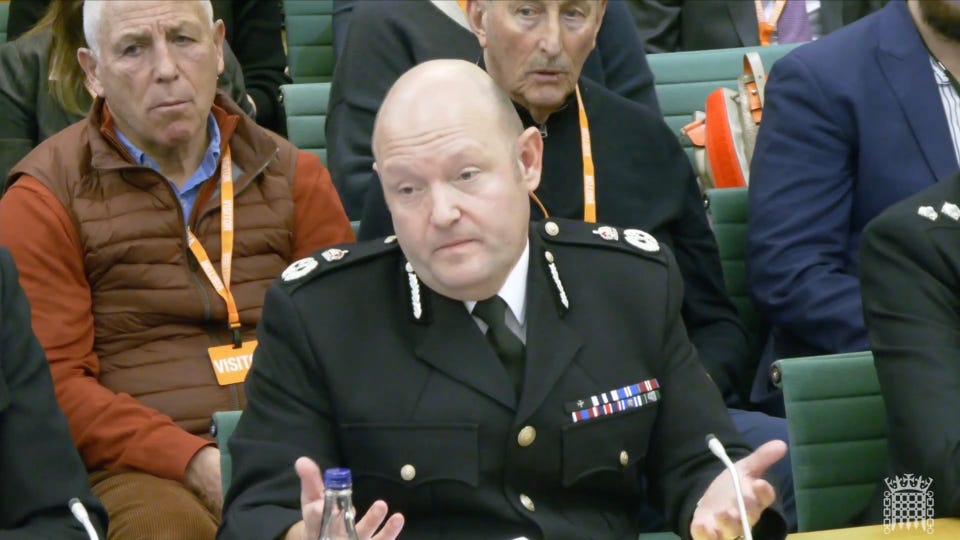
WMP later admitted errors, with Chief Constable Craig Guildford acknowledging that the 5,000 officer figure was an “estimation” and that the West Ham reference was a mistake. But these admissions came only after intense scrutiny, including from the Home Affairs Committee, which is now seeking further clarification from Dutch police.
Local political pressures
Digging deeper, evidence suggests the ban wasn’t primarily about Maccabi fans’ past behaviour but about appeasing local tensions in Birmingham, a city with a large Muslim population and vocal pro-Palestinian activism. Intelligence gathered by WMP as early as September 2025 revealed that “elements” of the local community were planning to “arm themselves” and target Israeli fans, driven by “a huge degree of consternation” over the match. Assistant Chief Constable Judi O’Hara confirmed during parliamentary questioning that the decision was influenced by fears that the fans would “come to harm from UK extremists.” So why did WMP turn it around and say the Israeli fans were the issue and put out the most disgusting lies about them?
Local MPs and community leaders reportedly lobbied WMP to prevent the fans’ arrival, citing potential protests and violence. This aligns with broader concerns about sectarian divisions in the UK, exacerbated by the Israel-Hamas war. Critics argue that by banning the victims rather than addressing the threats, WMP engaged in a form of “appeasement” to avoid confronting radical elements. Reform UK leader Nigel Farage called for Guildford’s resignation, accusing him of spreading “misinformation.”
Adding to the scandal, WMP claimed the local Jewish community supported the ban, another lie they were forced to retract and apologise for, admitting there was “no documented feedback” from Jewish groups. UEFA itself recommended the match proceed with both sets of fans, but WMP ignored this advice.
Reports from The Times further allege that WMP produced false evidence retrospectively to justify a decision already made under pressure. This included exaggerating risks and misrepresenting a single, unrecorded briefing with Dutch counterparts as comprehensive intelligence.
A crisis of trust in the Police
This isn’t just a football story, it’s a stark example of how geopolitical tensions can infiltrate domestic policing. Jewish organisations, including the Board of Deputies and the Jewish Leadership Council, have demanded Guildford’s ouster, labelling the ban discriminatory. Israel’s Foreign Ministry has called for “action and accountability.” The UK’s independent adviser on antisemitism, Lord Mann, accused WMP of “conflating” facts and using “inaccurate” intelligence.
As of January 2026, parliamentary probes continue, with MPs like Nick Timothy and Ian Austin seeking direct input from Dutch authorities to uncover the full extent of the misinformation. The case highlights potential biases in policing, where fears of community backlash may lead to decisions that unfairly target minority groups. If substantiated, it could erode public confidence in law enforcement and prompt reforms in how intelligence is gathered and verified for high-profile events.
In the end, what started as a precautionary ban has unraveled into a tale of inverted victimhood, fabricated details, and political cowardice. Birmingham’s streets may have been quiet that night, but the echoes of this scandal will resonate far beyond the pitch.