


Once you get away from Starmer’s weak and pathetic response to the strikes on Iran and his preaching of international law, it’s clear that President Trump’s bold actions against Iran were not only justified, they were imperative for global security. Trump’s strategy dismantled a regime built on anti-American hatred, countering China’s strategic manoeuvres, and reaffirmed U.S. leadership in a world of rising threats. Love him or hate him, we needed this to happen.
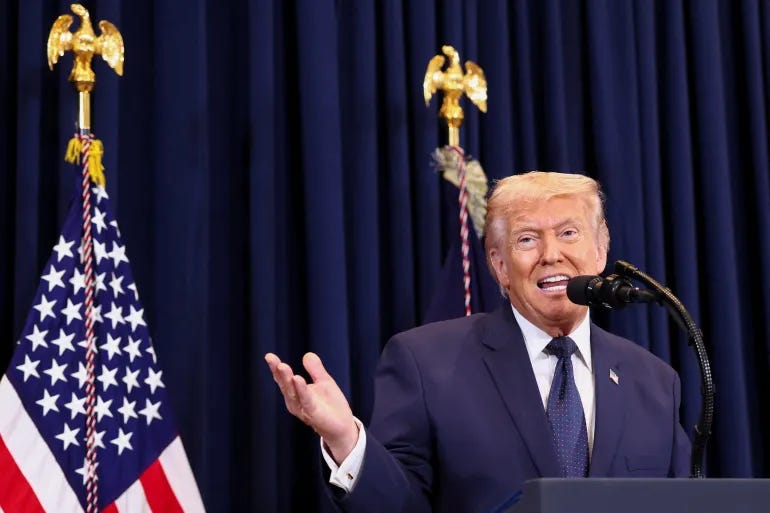
Trump needed to take a stand because no one else would
President Trump recognised early on that appeasement toward Iran was a dangerous illusion. Trump launched Operation Epic Fury following a firm ultimatum, targeting Iran’s military infrastructure and even striking Supreme Leader Ali Khamenei directly. This came after the 12 day war where Israel, with U.S. support, exposed Iran’s vulnerabilities, proving the regime was little more than cobwebs. Trump’s approach contrasted sharply with the failed policies of previous administrations, which allowed Iran to advance its nuclear program under the guise of negotiations.
Why was Trump right to take on Iran? Consider these critical reasons:
Iran’s regime, rooted in Ayatollah Khomeini’s ideology, is inherently anti-American, anti-British, anti-West, viewing the U.S. as the Great Satan and incapable of peaceful coexistence.
By targeting assets like Iran’s navy and ports in the Indian Ocean, Trump removed Iran from serving as a proxy in broader conflicts.
Trump’s actions thwarted Iran’s attempts to assassinate him, avenged U.S. nationals killed on October 7, and halted Houthi attacks on global shipping, restoring order in key international waterways.
These moves showcased Trump’s willingness to act decisively, unlike the hesitation that allowed Iran to flourish under Obama and Biden, who kept with the negotiating route giving Iran time to develop their technology and ultimately achieving nothing.
Iran’s history of evading nuclear inspections
Iran’s nuclear program has been shrouded in deception for over two decades, consistently flouting international obligations under the Nuclear Non-Proliferation Treaty (NPT). The interview highlights how Iran faked negotiations for three decades, building underground capabilities while stalling inspectors. The program was way too big for a research program, simultaneously way too small for an energy program, it was a weapons pursuit.
This evasion is not new. Key instances of non-compliance include:
In 2003, the IAEA’s first resolution criticised Iran for secret uranium enrichment at Natanz and undeclared uranium processing, marking the start of 20 years of failures to remedy breaches.
By 2020, Iran blocked IAEA access to sites suspected of past nuclear activities, attempting to sanitise locations and obscure evidence of undeclared materials.
In 2021, Iran suspended the Additional Protocol, ending snap inspections, and by 2025, after U.S. strikes, outright rejected IAEA access to bombed sites until post-war conditions were defined.
Ongoing restrictions, such as withdrawing cameras and limiting monitoring, have persisted, with the IAEA declaring in 2025 that Iran was not complying with safeguards, unable to verify the program’s peaceful nature.
These violations underscore Iran’s intent to develop nuclear weapons, buying time through insincere talks like the 2015 JCPOA, which ultimately were ineffective due to Iran’s continued deceit.
China’s complicit role in Iran’s nuclear ambitions
No discussion of Iran’s threat is complete without examining China’s involvement, turning turns Iran into a proxy Chinese weapon against U.S. interests. China has bolstered Iran’s capabilities, providing a lifeline that prolonged the regime’s survival until Trump’s intervention.
China’s support of Iran manifests itself in several ways:
Economically China imports 80-90% of Iran’s oil at discounted prices, building a massive strategic reserve to counter U.S. control of shipping chokepoints like the Malacca Strait. In 2025 alone, China imported 1.38 million barrels per day from Iran, about 12% of its total crude.
Militarily China has upgraded Iran’s missile programs, supplying components, training engineers, and helping move facilities underground to evade detection. This includes air defence systems, anti-ship missiles, and ballistic missile tech.
Strategically The 2021 25-year partnership pledged $400 billion in investments for oil access, while China provides ports like Chabahar and cyber testing grounds, enabling Iran to disrupt global oil flows if needed.
Despite public opposition to nuclear weapons, China’s actions speak louder, offering technical assistance and dual-use items that advance Iran’s program. Trump’s strikes targeted this alliance, removing Iran as a proxy and forcing China to reckon with U.S. resolve.
Starmer is weak when the world needed strength
Again putting aside Starmer’s lack of support for the greatest ally of our time. Trump’s confrontation with Iran was a necessary action that exposed the regime’s deceptions, halted its nuclear march, and disrupted China’s geopolitical games. Starmer and his international law excuse only serves to justifies inaction, whilst Iran flout his beloved international law at every point, but Trumps decisive leadership protects the free world. This reinforces why strong, unapologetic American foreign policy remains essential.